Classifying Vices
Vices are classified by shared behaviors and characteristics. Theses classifications provide insight on expected Vice behaviors and are crucial in preparing properly for rescission.
minute readVices are classified by shared behaviors and characteristics. Theses classifications provide insight on expected Vice behaviors and are crucial in preparing properly for rescission.
minute readFor more information, call us at (214) 877-8423 or send an email to info@cvrs.com.
Receiving a professional classification is encouraged, as some Vices are known to be deceiving or are difficult to observe. While the classifications outlined below serve as a general guide for understanding these Vices, anomalies can and are likely occur. Please contact info@cvrs.com with any anomalies, questions or concerns. Before diving into classifications, we recommend familiarizing yourself with The Branch Phenomenon to establish a foundation in Branch mechanics.
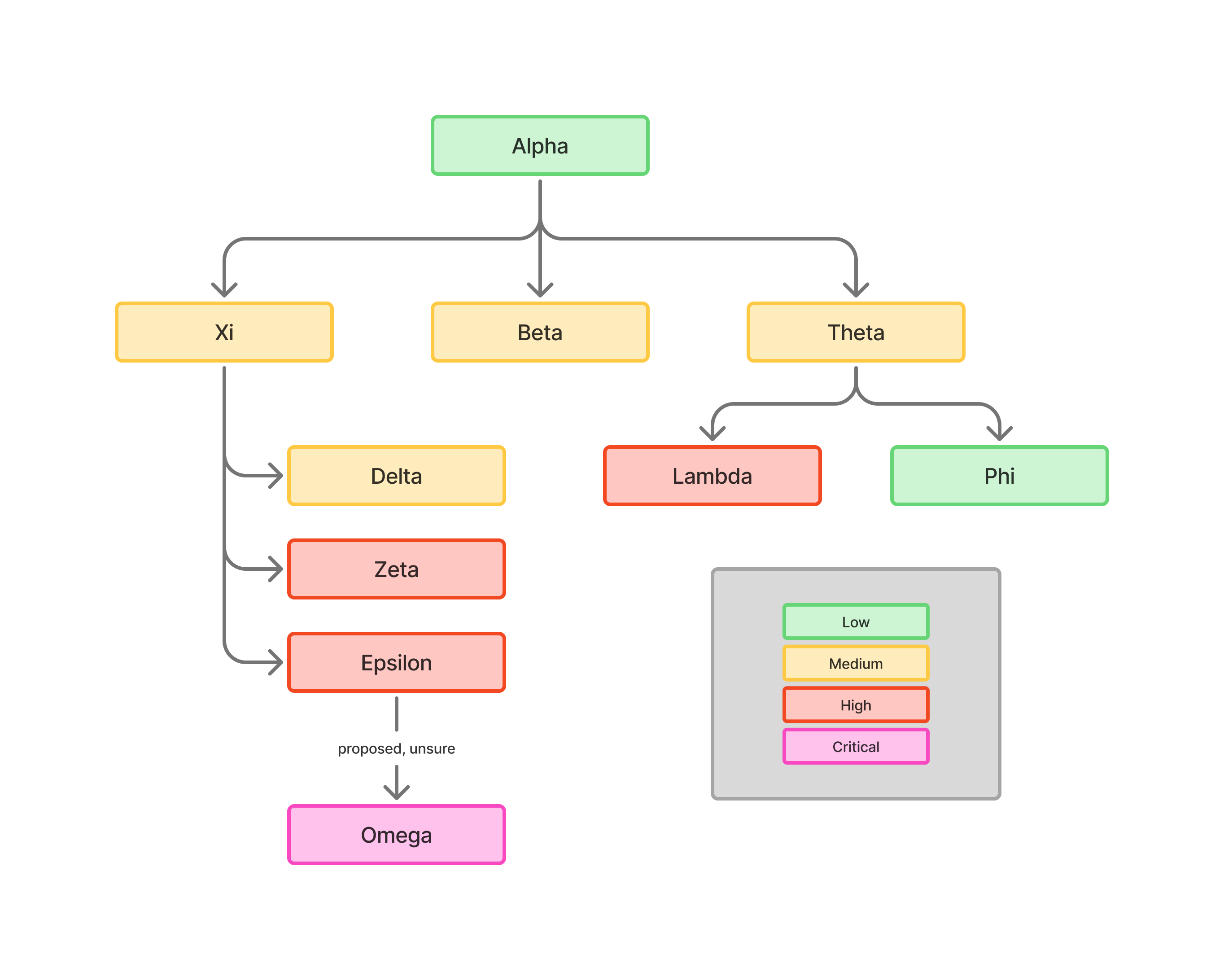
Vice classifications can be further categorized by their threat level, ranging from low to critical. This threat level informs Record Proctors and Vice Management Administrators on what materials or staff are needed for treatment and determines the probability for success.
Vices with a low threat level can often be rescinded without Adjuncts. Patches are recommended if planning to self-treat. If desired, Vices in this category can be treated with exposure rescission.
Adjuncts are encouraged when addressing Vices with a medium threat level. Patches are also encouraged if planning to self-treat. Professional treatment via CVRS provides the highest chance of a successful rescission.
Multiple Adjuncts and patches are mandatory when addressing Vices with a high threat level. Self-treating is not advised. Establishing a CVRS care team early in the Vice’s life cycle is imperative to a successful rescission.
Rescission is not guaranteed and is unlikely, regardless of Adjuncts, patches, and preparation. This threat level is reserved exclusively for Omega Vices.
Primary classes serve to inform Hosts of their Vice’s expected behavior. A Vice's classification is synonymous with its primary class. The classes outlined below each have their own page that goes into more detail and provides high-level guidance on approaching rescission for each life stage, as well as expected Branch Policies, and a recommended care team. We recommend that all Hosts, regardless of their Vice’s threat level, seek counsel and treatment from a CVRS team.
Classification is not an instantaneous process. Multiple appointments and consultations with a Record Proctor may be required to perform accurate classification. Classifications may change in the early larval stage as they reveal more information, but anomalies at any stage are likely to occur. Some classifications are capable of deceit and restraint, making accurate classification difficult, and some even mimic others in early life stages.
8 minute readAlpha Vices are the most common of the classifications, making up 65% of all Vices. These Vices are typically straightforward to treat due to their relatively predictable nature and low intelligence. Alpha Vices are generally considered to be the initial pool from which all other Vices evolved and deviated.
Learn more about Alpha Vices 8 minute readBeta Vices are often viewed as the more intelligent, “evolved” version of Alpha Vices. Due to their gradual advent, these Vices have a more complex Branch Policy and higher threat level compared to Alpha Vices. Their prioritization of germination results in complex, well-established networks and small, elusive cores.
Learn more about Beta Vices 12 minute readDelta Vices are a unique, elusive classification that can be tricky to treat without the proper resources. These timid Vices undergo the unique process of core “shedding” when threatened, wherein the Vice abandons both the Branch Domain blueprint and exhibition presentation properties of its Branch Policy. This disorienting defense mechanism often results in the Host’s memory loss.
Learn more about Delta Vices 11 minute readEpsilon Vices are extremely difficult to treat due to their deceptive nature. While Delta Vices shed, Epsilon Vices instead opt to keep parts of their Branch Policy hidden. Information can be gathered for all properties, but it may be incomplete. Epsilon Vices will use this gap in knowledge to their advantage to surprise Hosts and Adjuncts in the Branch Domain by expanding hidden areas of the domain or even revealing previously shrouded exhibition characteristics.
Learn more about Epsilon Vices 10 minute readA Zeta core has a unique epithelium that attracts hormones from throughout the body, acting as a lightning rod that allows them to feed consistently through all life stages. Because of this, Hosts with Zeta Vices tend to display extreme, visible signs of fatigue. These Vices have advanced storage capacity and are able to hoard more resources than the average Vice, in addition to having a penchant for establishing rumina. If allowed to mature, Zeta Vices can be extremely difficult to address due to their established, often numerous energy reserves.
Learn more about Zeta Vices 8 minute readTheta Vices thrive on chaos and are notorious for their trademark explosive Branch after a period of sustained feeding. Theta Vices have a wider-than-average staging radius and aim to admit as many tertiary Adjuncts as possible to this attempted dispersion. Though intimidating, these Vices can be easily addressed if caught early.
Learn more about Theta Vices 7 minute readLambda Vices are a relatively rare classification of Vice that deviates from all expected behavioral norms. Lambda Vices always have a sudden advent, but the Branch initiated at advent is leaps and bounds more complex than any other classification’s. Hosts with a Lambda Vice should be addressed by a Branch Administrator. If the Branch is addressed, future Branches will drastically decrease in severity.
Learn more about Lambda Vices 9 minute readXi Vices are often misclassified as Alpha Vices due to their relatively predictable early life. As these Vices mature, Branches become more complex, including exhibitions. While some tweaking to the Branch Policy between Branches is to be expected, the rate at which these properties evolve in Xi Vices can quickly become threatening.
Learn more about Xi Vices 2 minute readPhi Vices are a somewhat uncommon and bizarre classification that is so chaotic and dysfunctional in its makeup that it barely has enough energy to maintain its form—let alone the Branch initiated at its sudden advent. While these brittle Vices can easily be addressed, Hosts should remain vigilant, as the advent of a Phi Vice indicates a susceptibility to infection that can result in contracting another Vice.
Learn more about Phi Vices 3 minute readThis extremely rare classification is often applied post-dispersion, as the properties of Omega Vices tend to shift in unexpected, unprecedented ways that other classifications do not, often resulting in lethal misclassifications. The Omega classification is reserved for Vices that cannot be categorized by any of the other classifications, essentially acting as a fringe category of Vices.
Learn more about Omega Vices 8 minute readIn certain cases, further classification may be applied to provide a more complete understanding of a Host’s Vice, called subclasses. Subclasses differ from primary classes in that they are unique behaviors or characteristics found throughout all classifications. They are typically concerned with a single behavior or characteristic, rather than a set of criteria.
Learn more about the individual subclassesAs stated in Evolution and Intelligence, Vices continue to evolve at an alarming rate. As new behaviors are established, our Behavioral Analysts present possible classifications and sub-classifications to help prepare our agents.
It is understood that all Vices originated from Alpha Vices, with Beta, Xi, and Theta being the first classifications to branch off. While it is relatively difficult to follow the exact path of evolution due to their reproductive method, the chart below gives us valuable insight into shared behaviors and can even aid in constructing plans of attack.
Our agents are eager to help our patients achieve their Vice goals. Whether they’re looking for support as they self-treat or are pursuing rescission, we’re here to help.
Browse Our Admission Guidance