Host Statuses
Hosts have a variety of statuses that communicate urgency and drive treatment plans. While a Host is infected, they can further be categorized by the degree that the Vice has spread within their body.
minute readHosts have a variety of statuses that communicate urgency and drive treatment plans. While a Host is infected, they can further be categorized by the degree that the Vice has spread within their body.
minute readFor more information, call us at (214) 877-8423 or send an email to info@cvrs.com.
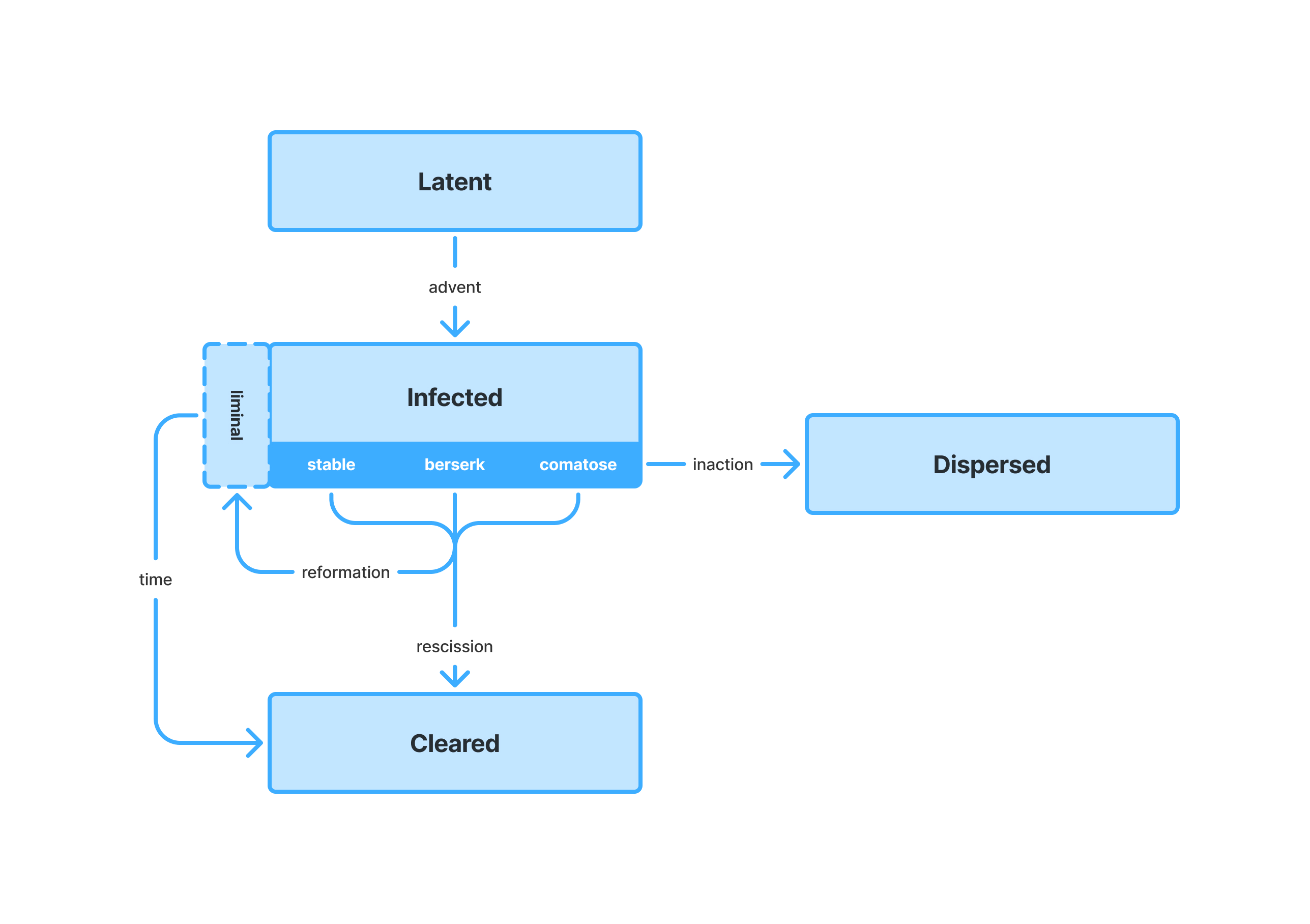
This status is referred to primarily in retrospect, when agents are studying or discussing advent properties and the experiences that may influence a Vice’s Branch Policy. A Host’s physiological, biological, and even psychological status during latency can provide valuable information to CVRS agents and can even aid in classification. For example, Zeta Vices are often birthed after periods of extreme depression, while Delta Vices tend to manifest after drastic life changes.
A Host is officially infected once a Vice has been successfully detected with a Vitiumglomerorum Detection Scan (VGDS), the diagnostic screening performed by a Record Proctor following a brief screening questionnaire. This rudimentary scan detects dense concentrations of VG in the Host’s body using a VG Meter; a localized reading of 4.0 or higher indicates the presence of a Vice core.
After advent, the Vice’s core size and growth progress can be monitored with regular Vitiumglomerorum Management Scans (VGMS) ordered by a Vice Management Administrator and performed by a Record Proctor. These scans produce low-resolution black and white images much like an ultrasound and determine the size and density of the Vice core. Classification can now occur based on the information gathered at advent and its behavior between the initial Branches; however, classification is not guaranteed and largely hinges on the Vice’s behavior in its early life. Most Vices are classified within 6 months of advent.
Shortly after advent, the Host’s body begins producing antivitiumglomerorum (AV) as a direct response to the invasive parasite. Over time, an infected Host’s body will learn to control and concentrate the flow of AV, which can result in establishing a patch. Learn more about this process in AV & Patches.
While a Host is infected, they fall into one of three categories: stable, berserk, or comatose, with a fourth “liminal” status reserved for Hosts with reformed Vices. These substatuses are determined by the Vice’s behavior and how the Host’s body is reacting to it, as outlined below.
While a Host is infected, they will spend the majority of their time in this phase. Being stable does not imply the Host is asymptomatic or not at risk; rather, it means that both the Host and the Vice are behaving “in character”. Blights are not agitated and the Vice core is not growing at an alarming or unnatural rate.
Hosts experiencing Branches are still considered stable, so long as the Vice is not performing excessive augmentation or germination. A stable Host’s immune system is on standby, monitoring the Vice core activity.
Stable Hosts do not typically exhibit blights, though Hosts with mature Vices will sometimes display consistent, mild blights such as sharpened incisors or small, nubby horns, known as chronic blights. These blights are caused by concentrations of VG rather than exacerbated Vice activity. Acute blights are typically only observed during Branches, and are expected to resolve after the Branch has been addressed.
A Host becomes berserk when the Vice pursues considerable core growth—a process known as augmentation—during a the production stage of a Branch. While Vices can augment their core outside of Branches, it is performed at a near-imperceptible pace that does not alert the Host’s immune system. The growth that results in a berserk Host is sudden and brazen, some Vices being able to double their core size during Branches.
During augmentation, the Host’s immune system is deploying its natural defenses against threats, which includes flooding the body with hormones like adrenaline and cortisol. As discussed in AV and Patches, our bodies have adapted to release AV alongside hormones as a defense mechanism against a Vice’s network deploying its tracks to ensnare the passing hormones. Because the body is being overrun with VG during this time—and because VG and AV cancel each other out—the AV is eventually overwhelmed by the sheer number of VG released from the Vice’s tracks. This steady supply of hormones fuels the Vice’s core growth for the remainder of the Branch.
Due to the increase in VG throughout the body, blights are visibly agitated in this phase. Extrusion blights grow in size, drape blights expand in surface area, and expulsion blights increase their output. Berserk Hosts will have different reactions depending on their relation to the Branch Domain. Inside the Branch Domain, berserk Hosts can become erratic, impulsive, and even hostile. Outside of the Branch Domain, a Host’s muscles will be taut and their jaws are likely to be clenched, often resulting in small tremors that can manifest as hypnic jerks, which risk Adjuncts breaking contact with the Host. Berserk Hosts with weaker immune systems are also at risk of excessive sweating, uncontrollable coughing, emesis, and even seizures, even further increasing the risk of losing their Adjuncts.
If possible, it is highly recommended to pursue rescission if a Host is berserk. Committing a Branch will stabilize the Host, but there will be less time between Branches compared to committing Branches when a Host is stable. For example, if a Vice typically has two to three weeks of down time between committed Branches, committing a Branch while the Host is berserk will likely result in only a week of down time. Suspending the Branches of a berserk Host is likely to do more harm than good and should only be performed as a last resort. If a Branch goes unaddressed, a Host will become comatose as the Vice begins to initiate fusion.
A Host becomes comatose once the Vice core has begun the process of fusing its recently expanded core with the Host’s body. Fusion is the process of the Vice core infiltrating organs and viscera and intertwining its makeup with these structures. As the contents of the Vice core mix with the viscera, this mixture becomes extremely rigid and solidifies, essentially killing the tissues it has fused with. Learn more about fusion in Reactivity and Defense Mechanisms.
During this time, the Host’s body is shutting down and losing motor control. Because the core is often fused with hormone-secreting organs, such as the pituitary gland or brain stem, the overproduction of hormones is triggered even further, fueling the Vice’s continued expansion and fusion. Comatose Hosts exhibit the same physiological symptoms as berserk Hosts, though they do tend to be exacerbated. Because of the unrestrained release of hormones, Hosts can also develop severe acute reactions, such as serotonin syndrome or thyrotoxicosis.
Due to the increase in VG throughout the Host’s body, Blights are extremely agitated and out of control, potentially causing harm to those around them. Within the Branch Domain, Hosts may find it difficult to think clearly and make rational decisions. Some even feel like they have less control of their body and find it twice as difficult to move in the ways they intend to. Adjuncts are imperative to success in this phase.
While the core is fused with the Host’s body, doing so has stretched it extremely thin, making the core vulnerable in both the corporeal and metaphysical realms. Due to this vulnerable state, rescission is still achievable, even if a Host is comatose. If a Host is able to rescind their Vice during this phase, the Host will be cleared but will likely suffer extreme lingering blights and can even develop autoimmune disorders, damaged joints and chronic pain. In extreme cases, amputations or organ transplants may be needed. AV Shots may buy the Host time, but are ultimately futile at this phase, as the VG coursing throughout the Host’s body almost immediately defuses the burst of AV.
If a Host is unsuccessful at rescission, the Vice will complete the fusion process and begin the act of dispersion.
In the rare instance of reformation, a Host can still be infected, but at a much lower risk of dispersion and Branch initiation. The components of a Vice are still present throughout a liminal Host’s bloodstream, but the core and its network are in a scattered, disconnected state. Vices that have been reformed cannot feed on hormones or initiate Branches, but they do have the very low probability of congealing and re-establishing the core. Hosts with reformed Vices are able to use their power to bolster their extension in the Branch Domain by taking on the form of its exhibition. Learn more about the process of Vice reformation in Fringe Branch Events.
Reformed Vice cores are immediately dissolved in a fluid and scattered throughout the body, while the Vice’s network stays relatively intact, but cannot function as intended. While the general layout of the Vice’s network remains unchanged, it cannot transport VG or hormones. Because it has lost contact with the core, the network begins steadily leaking the remaining VG and hormones out into the Host’s bloodstream.
Due to the VG now circulating freely in the Host’s body, Hosts are much more susceptible to agitated, chronic blights. While annoying, these typically pose only minor threats, depending on the original severity of blights. AV Shots can be administered for blight management, but also lessens the time a Host is able to wield their reformed Vice. Liminal Hosts have reported being more sensitive and reactive during this time, generally attributed to the supplementary hormones leaching into the bloodstream.
Reformed Vices typically cycle through the Host’s bloodstream for roughly a year. The Host’s steady deployment of AV eats away at the scattered remains of the Vice core, but summoning the Vice’s exhibition in the Branch Domain can deplete the core by up to 50%. As the percentage of the core decreases, the severity of chronic blights decreases as well.
Rescission is the act of destroying a Vice core, so once the last bit of the core is passively destroyed by the body’s AV or it is used to bolster the Host’s extension in the Branch Domain, the Vice is officially rescinded. This process is not dissimilar to exposure rescission. Even if a liminal Host has stopped having blights, it is recommended that they visit a Vice Management Administrator to confirm rescission.
A cleared Host is the result of a successful rescission, which is only achieved once the Vice core is destroyed. Rescission can be achieved in multiple ways, further explored in Primary Care Services: Rescission.
More mature Vices tend to leave trace amounts of its network behind after rescission. Similar to the experience of liminal Hosts, these lingering fragments can result in chronic blights, though they are often much less severe, as the remaining network of a rescinded Vice tends to be relatively incomplete. A Vice Management Administrator or Blight Specialist can help with lingering blights and facilitate post-rescission treatment, if needed.
Cleared Hosts become more susceptible to contracting another Vice as time progresses. Experts posit that cleared Hosts have a higher tolerance to VG and consequently require a higher concentration of it to spark another advent, but over time, this tolerance is likely to lower.
The passages below contain information that may be uncomfortable for some readers. The act of dispersion entails the mutilation of the human body, which is discussed below. Proceed with caution or skip to the next section.
This status is applied to Hosts postmortem, as the process of dispersion kills the Host. Dispersion is the result of an unaddressed Branch, where a Vice was able to expand its core throughout a comatose Host’s body and perform the act of fusion, wherein its entangled core hardens and clings onto the organs and viscera around it.
In the blink of an eye, the Host’s body is sucked in on itself and absorbed into the Vice’s core. It quickly recedes into a dense ball of flesh, no more than two inches, then explodes in a violent burst that sends a wave of VG in every direction.
Hosts who have been dispersed are unable to be reclaimed, even in small amounts, as the act of retracting the Host’s body into the core liquefies its contents to be utilized as fuel for the explosive dispersion of VG. Learn more about this process in Vice Reproduction: Dispersion.